
Coordination, unrecorded
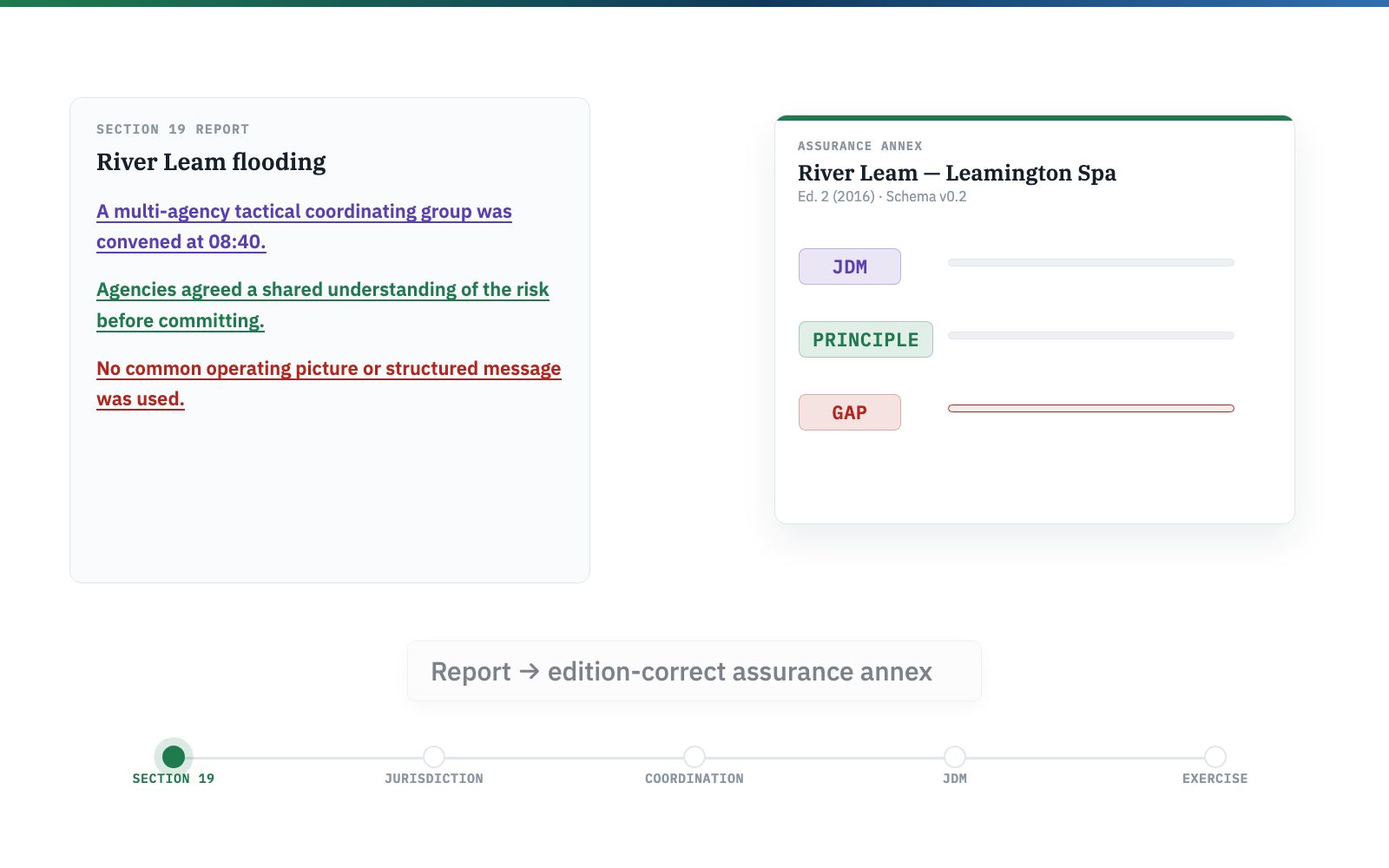
Section 19 reports document multi-agency activity in detail but are not written to evidence joint-working effectiveness — and in practice never reference JESIP, the doctrine governing how agencies coordinate.
UK flood response depends on many agencies working together under JESIP — yet the statutory Section 19 record was never built to evidence how they coordinated. This platform turns that record into an edition-correct, defensible assurance annex, on an openly-licensed standard.
The problem
Underpinning research scoping-reviewed eleven Warwickshire flood events against JESIP and the Civil Contingencies Act, and found interoperability doctrine absent from the statutory record. UK inquiries repeatedly turn on exactly this missing joint-working evidence.
Section 19 reports document multi-agency activity in detail but are not written to evidence joint-working effectiveness — and in practice never reference JESIP, the doctrine governing how agencies coordinate.
Any credible record must judge an event against the JESIP edition in force at the time. Edition 2 reached only blue-light services; Edition 3 first extended to Cat 2. No current process captures that distinction.
As flooding grows more frequent and severe, authorities cannot systematically learn what coordination failed — because the record was never structured to show it.
How it works
The calm-time core turns a Section 19 report into an assurance annex — the author stays in control throughout, the tool proposes with rationale, nothing is asserted without human approval. That same structured record then powers four more modules across the incident lifecycle.
The core — Section 19 to assurance annex
Drop the published Section 19 report. Text is extracted locally, on-device.
The JESIP edition in force on the event date is resolved deterministically.
Interoperability passages are tagged against the schema — each with a rationale.
Accept, edit, reject or add every tag. Nothing finalises without approval.
Export an edition-correct assurance annex with a doctrine-gap summary.
The platform — five modules across the incident lifecycle
Who it's for
Authors Section 19 reports under time pressure. Gets interoperability captured at near-zero effort — plus faster, more consistent report sections they can use immediately.
Accountable when interoperability is questioned after an event. Gets defensible, edition-correct evidence on demand — proof rather than hope when an inquiry asks.
Studies multi-agency coordination. Gets a published, openly-licensed schema and a comparable dataset across events that no single narrative report reveals.
Open standard
The tagging vocabulary is a public good — versioned, openly licensed, and usable without the tool, so researchers and other authorities apply the same standard and the data becomes comparable across events.
No licence fees. A public good held by a CIC under an asset lock — it cannot be enclosed.
Reports processed on-device by default; a DPIA-aligned model keeps personal data on your workstation.
The tool structures evidence with a rationale on every tag. Humans judge compliance — it never does.
Schema and tool openly licensed and versioned, so the community can maintain them as doctrine evolves.
Roadmap
The build sequenced outward from the evidence-proven calm-time core to the highest-value live coordination layer. All five modules are now live across the incident lifecycle — from Section 19 Assurance, through Jurisdiction Resolver, Coordination Layer, JDM Decision-Capture, to Readiness Micro-Exercise.
Turns a Section 19 report into a JESIP-traceable assurance annex, with an openly-licensed tagging schema underneath.
Resolves which authority owns what at a flood incident under the Flood and Water Management Act 2010 (main river / ordinary watercourse / surface water / groundwater / sewers → EA / LLFA / IDB / water company / riparian owner).
A lightweight browser/mobile common-operating-picture + M/ETHANE / JDM layer for non-blue-light Cat 1 and Cat 2 responders excluded from Airwave/ESN.
A guided Joint Decision Model workflow timestamping decisions and rationale into an immutable joint decision log, with anti-inertia prompts.
Low-cost, low-time multi-agency flood-coordination micro-simulations for responders who cannot afford full LRF exercises — closing the data flywheel (reports → structured data → drills).
All five modules are live — from Section 19 assurance to jurisdiction, coordination, joint-decision capture and readiness drills. Explore them with sample events.